Center of Attention
Why one of the world’s tiniest countries gets the biggest international spotlight

"A reliable way to make people believe in falsehoods is frequent repetition, because familiarity is not easily distinguished from truth."— Daniel Kahneman, Nobel laureate, Thinking, Fast and Slow (2011)
Name one news story out of Sudan this year.
Sudan is the largest humanitarian catastrophe on Earth, in the words of the World Health Organization: 13.6 million people driven from their homes, "the largest displacement crisis in the world," 33.7 million in need of aid. Famine has been formally declared — the first such declaration in more than seven years. The United States has determined that a genocide is being committed there. When the city of El Fasher fell in late 2025, the UN documented more than 6,000 killings in the first three days, including a massacre of more than 460 patients inside a maternity hospital.
Now name a news story about Israel.
That asymmetry is not in your head, and it is not an accident of your social feed. It is a measurable fact about the world's media.
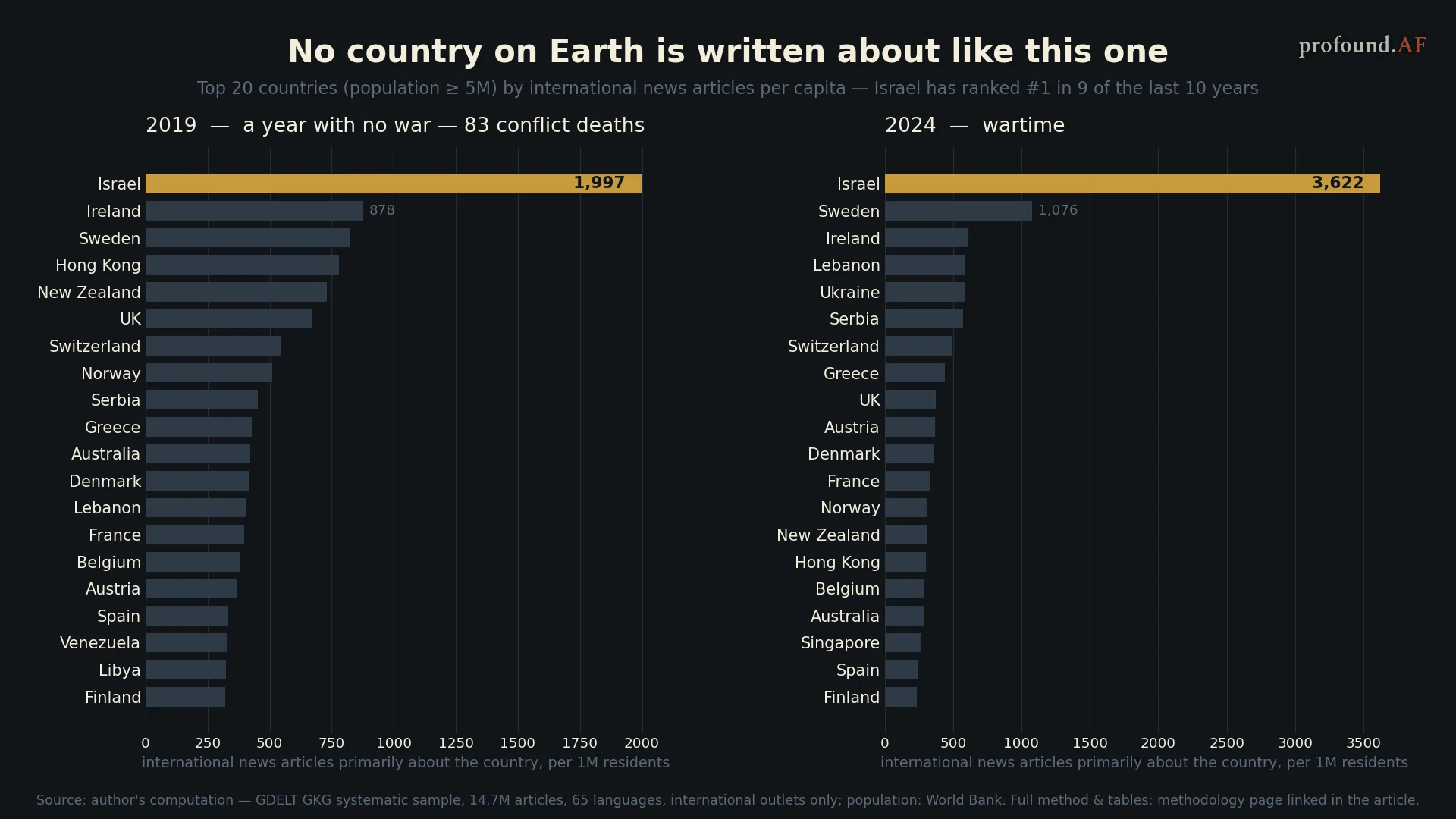
Israel is a country of 10 million people. It holds 0.12% of humanity on a territory smaller than New Jersey. And in 9 of the last 10 years, it has been the subject of more international news coverage per capita than any other country on Earth — double to quadruple the rate of any Western democracy, 7 - 16x more than Canada, 50 - 137x more than Brazil, 200 - 600x more than India. In 2024, 1 out of every 50 news articles published anywhere on the planet, by outlets outside Israel, was primarily about Israel — and in absolute terms only the United States, a country 34x its size and the world's hegemon, was the subject of more.
Why does a country the size of a mid-tier metropolis city command a fixed, permanent, disproportionate share of the entire world's attention, decade after decade, mostly in a negative register — while catastrophes 10 and 100 times larger pass in silence? The size of the spotlight, its persistence, and its tone are facts. They can be measured. And once you measure them, only one class of explanation survives: the spotlight is not a response to events. The spotlight is the operation — aimed at making Israel the thing you think about. The thing that infuriates you.
What follows is the measurement, and then the question of who is pointing the spotlight and why.
My methods
Everything in this piece that reads like a statistic is either my own computation from public data or a quoted, linked source. For my own numbers: I sampled 14.7 million news articles from the GDELT Project — the largest open index of the world's news, spanning outlets in 65 languages — evenly across every year from 2017 - August 2026, and counted, for every country on Earth, the international articles about it (its own domestic press excluded; every country treated identically).
For TV, I measured broadcast content directly: the share of airtime on CNN, Fox News, MSNBC and BBC News whose closed captions mention each country, using GDELT's processing of the Internet Archive's TV recordings. And as a check on the article sample, I ran a second, fully independent count of the articles — a complete census of GDELT's keyword index — and the two methods agree with a correlation of 0.958.
Population figures come from the World Bank. Conflict deaths are from the Uppsala Conflict Data Program's deliberately conservative event-verified counts. Every query, script, and raw file is published open-source on the methodology page.
The most propagandized country on Earth

Start with a year in which nothing happened. In 2019 there was no war in Israel. No invasion, no intifada, no October 7. 83 people died in the conflict that year — a toll on the order of a month or two of homicides in Chicago.
In that quiet year, 1 of every 112 news articles on Earth — from all the world's outlets minus Israel's — was primarily about Israel. 1.8 million international articles mentioned it. In absolute numbers, Israel ranked 7th in the world — ahead of Japan, India, Canada, Brazil, Australia, Mexico, Spain and Italy — with a population smaller than metropolitan Paris. Per capita, it ranked #1, as it did in 2017, 2018, 2020, 2021, 2023, 2024, 2025 and 2026.
Per capita is the honest measurement. Averaged over the decade, the world wrote about Israel 71x Brazil, 86x China, 283x India. Scaled to the world's full output, 2019 produced roughly one story about Israel for every seven Israelis. One about Brazil for every 340 Brazilians. One about India for every 1,550 Indians.
In 2024, 1 in every 26 of the world's articles mentioned Israel. The world published more than twice as many stories about Israel as about all 48 countries of sub-Saharan Africa combined — 1.3 billion people. More than about the entire Arab League. More than about all of South Asia — 2 billion people. On American cable news, Israel was the most-mentioned country — ahead of Iran, Russia, Ukraine, China. On the BBC's news channel, 1 in every 17 broadcast minutes mentioned Israel.
Who is writing all of this? In quiet years: mostly Israel's enemies. In 2019, 69% of the world's stories about Israel were published by outlets based in Muslim-majority countries — and more than half of the world total came from the Palestinian territories alone, led by WAFA, the Palestinian Authority's official news agency. The Western press wrote 24%. Then a war starts and the composition flips: in 2024, 60% of the world's Israel stories were Western. The data shows a permanent drumbeat of the Muslim world's state-dominated media and saturated coverage by the West whenever Israel defends itself.
Rank countries by stories per dollar of GDP: Israel is #1. Per conflict death, as we will see, the disproportion becomes obscene. And none of this is new: peer-reviewed research on global news flows found Israel and "Palestine" ranked 5th and 6th among all polities on Earth in world news salience. The researchers wrote plainly: "Surely, it cannot be explained by their size, population, or economic power."
The story that never ends
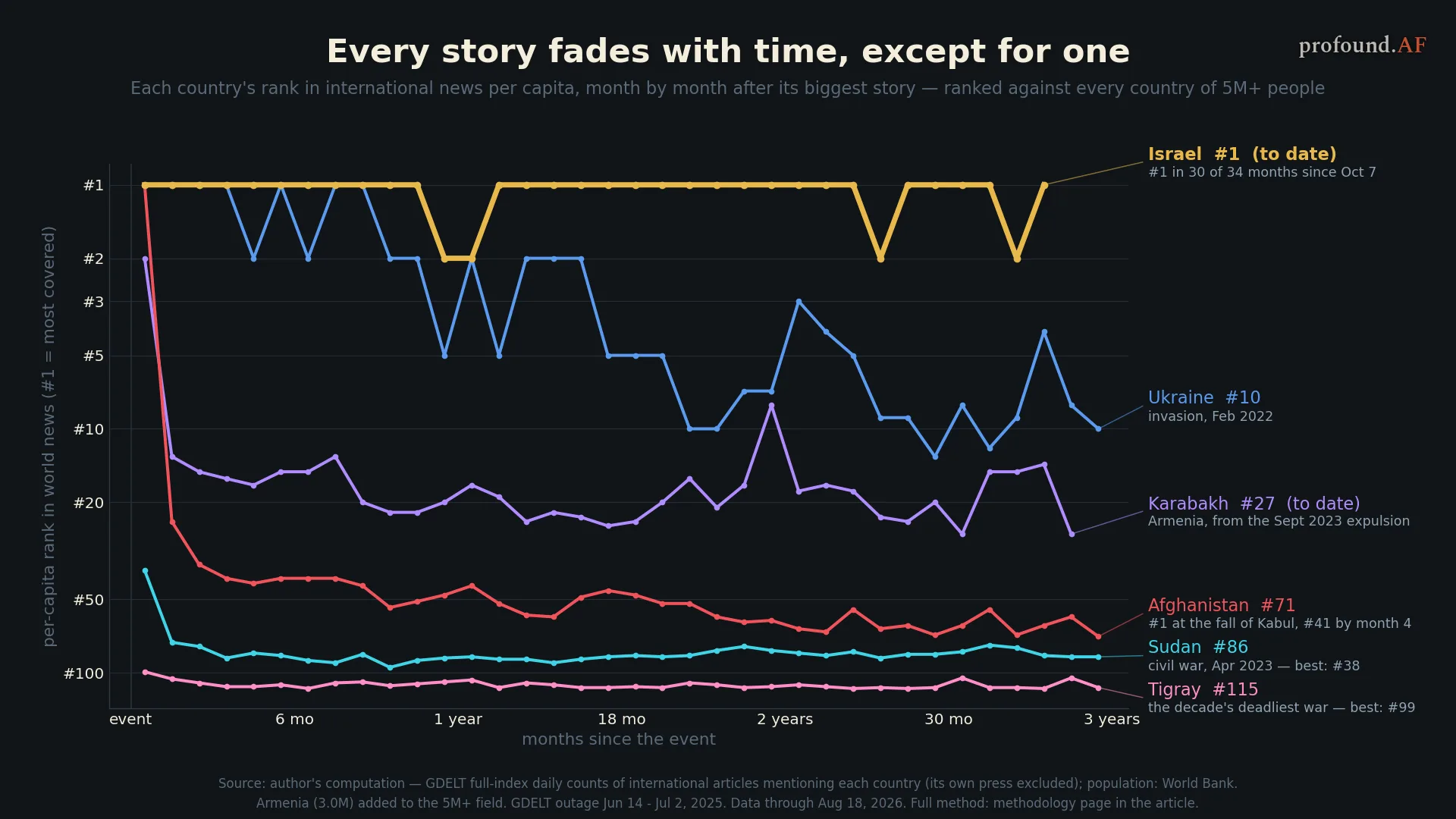
Coverage volume is half the phenomenon. The other half is time.
News attention is a decay function. A story erupts, peaks, and dies; the world moves on. This is so reliable it can be measured. So I did — daily television coverage on American cable, for every major eruption of the last five years, from event day to 2 years out.
Kabul fell to the Taliban in August 2021 and consumed 27% of all cable news airtime. 90 days later, Afghanistan was at 2% of its peak. A year later it barely registered. 20 years of war, gone in a season.
Sudan's war began in April 2023. Its coverage peak — 1.5% of airtime for a few days — was the week American citizens were evacuated. The war itself never made the cut: in the following 18 months, Sudan cleared 1% of daily airtime on only 8 days. The genocide determination, the famine declarations — none of it moved the needle.
The expulsion of 100,000 Armenians from Nagorno-Karabakh in September 2023 — an entire ancient community erased in a week, which the European Parliament called ethnic cleansing — never reached 0.1% of airtime. The Tigray war in Ethiopia, the deadliest war of this decade anywhere on Earth, never reached 0.05%. 1/1,000 of Israel's airtime.
Israel, after October 7, averaged 5.65% of all American cable news airtime for a full year — higher than even Ukraine's first-year average after the invasion — and 12 months in was still running at 27x its pre-war baseline. Ethiopia's coverage was flat through its own war — its deadliest year was its least-covered of the 3. Sudan's war nudged its share of world news from 0.18% to 0.32% for one year, then back down while the war grew worse. Myanmar's coup bump halved within a year.
In print, Israel coverage has accelerated over the 3 years since October 7th (2023 - 2.9%, 2024 - 3.8%, 2025 - 3.1%, 2026 - 3.6%). No decay — a total anomaly compared to the normal lifespan of a news story. Its floor — the share it holds in years when nothing happens — is a level every other small country on Earth touches only in the single worst week of its history.
Every story ends. Kabul ended. Karabakh was over in a month. Sudan was never allowed to start. But one story never ends. That is not how news works; that is how an influence campaign works.
No Jews, no news
The spotlight's size only means something against the darkness around it.
While Israel filled the world's front pages these past 3 years: Sudan's genocide killed at a scale still being counted — a Lancet-published study found 60,000 dead in Khartoum state alone with more than 90% unrecorded, and estimates run to 150,000 and beyond. Ethiopia's Tigray war had just ended — a war that PRIO noted produced "over 100,000 battle-related deaths in 2022, even more than Russia's invasion of Ukraine," and that the African Union's own mediator put at around 600,000 dead; population surveys later indicated roughly 1 in 10 Tigrayan women was raped. As the Guardian put it in a rare moment of self-awareness: "Though it is far deadlier than the war in Ukraine, the western media have mostly ignored it." In Congo, displacement hit 7.8 million — the highest ever recorded — and the UN reported that in the first 2 months, a child was raped every half hour(WTF?!!!). Yemen's war had already killed 377,000 by the UN's estimate. Syria's had killed 306,887 civilians by the UN's directly-documented count. Myanmar's military committed what the United States formally determined to be genocide. China put upwards of a million Uyghurs through camps — also a determined genocide, also ongoing.
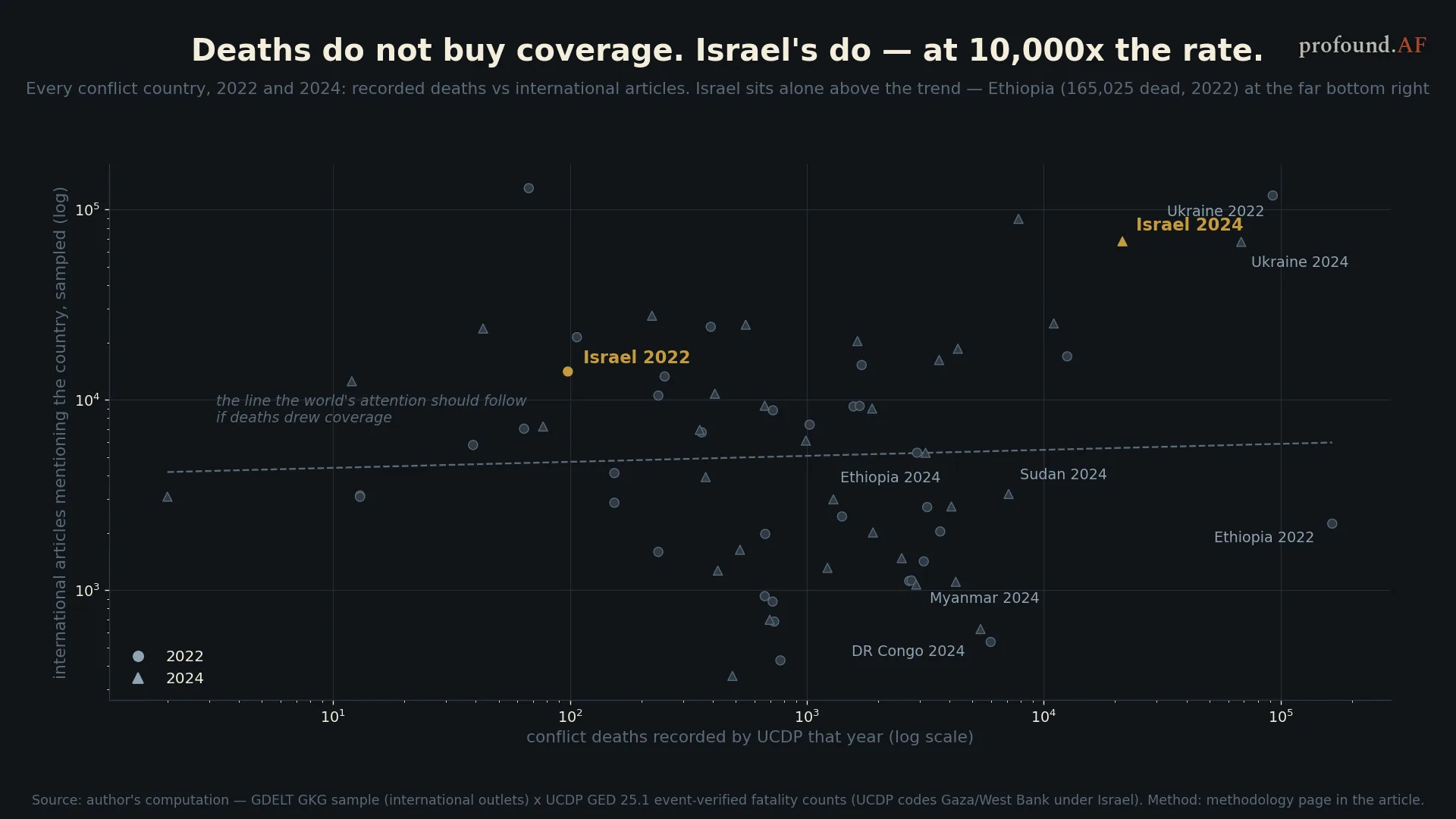
The people who run the world's emergency response say it out loud. The UN's relief chief, Martin Griffiths:
"Sudan is completely in the shadows... There's no justice in a world where you see such contrasts."
The register
So Israel is covered more than anyone, forever. Covered how?
Like the most heinous, despicable, devastating catastrophe — but even when at peace. My sample scores every article's tone. In quiet 2019, the language of Israel's international coverage averaged −2.3 on GDELT's scale, with half of all articles scoring below −2 — statistically the neighborhood of Lebanon, Venezuela, Iraq, Syria and Iran that year — while Canada, Switzerland, Sweden, Germany and Japan sat between −0.1 and −1.0. 61% of the stories about Israel carried conflict themes — killing, terror, armed conflict — the same share as Iran; for its Western peers the figure was 24%.
Switzerland is a country that occasionally has a news story. Israel is covered as a conflict that happens to contain a country. And this is not the Arab press dragging the average: in 2024, Western outlets' stories about Israel averaged −4.4, with 78% negative — a harsher register than the same outlets applied that year to Russia, Iran, or Syria. In the year of Bucha's aftermath and Iran's missile barrages, the Western press wrote about the Jewish state in darker language than any of them.
And the raw material inputs of that coverage — the numbers repeated in every one of those millions of stories? A study of 1,378 articles in major English-language outlets found that 98% cited the casualty figures of the Gaza Ministry of Health — an organ of Hamas, not only a terrorist organization but also a combatant in the war — while 5% cited Israeli figures. 84% drew no distinction between combatant and civilian deaths and "fewer than 1 in every 50 articles mentioned that the figures provided by the MoH were unverifiable or controversial."
A statistical analysis of the ministry's early casualty releases concluded the reported women-and-children ratios were "statistically impossible." Nobody can verify these numbers, but virtually nobody who repeats them says so. The most-repeated casualty figures on Earth are the least verified — sourced from terrorists, laundered daily through 5 million articles. A machine that behaves this way is not informing you. It's dosing you.
"If you aren't careful, the newspapers will have you hating the people who are being oppressed and loving the people who are doing the oppressing."— Malcolm X, 1964
Syndrome
In the 1970s, researchers proved that readers learn "how much importance to attach to [an] issue from the amount of information in a news story and its position." People judge how common and how important something is by how easily examples come to mind — and a classic study found the public's misjudgments of the causes of death precisely mirror the skew of newspaper coverage. Mere repetition makes claims feel true — even, as a 2015 study demonstrated, "when participants knew better."
Now run the experiment on a planetary scale: take one tiny country and give it several times the per-capita coverage of any nation on Earth, every year, for as long as anyone has been counting. Make the register extremely negative even in peacetime, and in wartime darker than that of Iran, where dissidents are hanged to death by the regime from cranes in densely-populated city centers. Never let the story end. What does the theory predict? A world convinced, without ever deciding to be, that this one country is the most important moral question alive — and the guiltiest.
And this is precisely what we observe. Among Americans under 30, a Harvard poll found support for a permanent ceasefire in Gaza 5:1 — while the same respondents ranked the issue near the bottom of their own priorities. Total opinionation, zero stakes: the fingerprint of manufactured salience. In Britain's 2024 election, Gaza was a motivating issue for 14% of voters under 25 — against 1 - 6% of every other age group — the generation raised on the platforms where, on the day of the October 7 massacre itself, X counted "more than 50 million posts" about Israel in two days. Over 100,000 Michigan Democrats voted "uncommitted" against their own president over a war on another continent. In a single year, Democrats' sympathies flipped to the Palestinian side for the first time in the poll's history.
And past a certain dose, the stimulus produces something stranger — a condition some call Israel Derangement Syndrome: the compulsion to insert Israel into places that have nothing to do with Israel, while the larger horrors of the age go unmentioned.
A YouTube educator for toddlers — beloved, apolitical — suddenly produced, in the words of a complaint filed with the US Attorney General, "over 50 times" more Gaza advocacy despite having "never previously engaged with the Israel-Palestinian conflict," and then vowed: "I would risk everything, and I will risk my career over and over to stand up for them." An ice-cream company declared a foreign policy — "inconsistent with our values for Ben & Jerry's ice cream to be sold in the Occupied Palestinian Territory" — litigated it against its own parent company for years, and its co-founder got himself arrested at a Senate hearing about health policy, shouting "Congress pays for bombs that kill children in Gaza"; his flavor-naming protest post drew 73,000 likes. In one American season, protesters glued their hands to Sixth Avenue to block the Macy's Thanksgiving Parade, blocked the access roads to JFK and LAX during holiday travel, chained themselves inside pipes across the Golden Gate Bridge under a banner reading STOP THE WORLD FOR GAZA, smoke-bombed the Met Gala, forced the Museum of Modern Art to close — and protested the memorial exhibition for the people killed at the Nova festival with signs reading "Long live October 7th," an act so grotesque the Biden White House issued a statement that "Antisemitism has no place in the United States."
The obsession runs through institutions that exist for other purposes entirely. Roughly 100 American city councils took up Gaza ceasefire resolutions within months — hearings running 6 - 8 hours, Chicago's passing only on the mayor's tie-breaking vote over an alderman's objection: "To pretend that we are international diplomats in this room..." Number of American city-council resolutions on Sudan's concurrent genocide: zero. Not because localities don't involve themselves in foreign policy. The entire municipal bandwidth of the United States went to one foreign conflict. Over New York's 2025 mayoral race — about housing and buses — Israel loomed from beginning to end: a country 5,700 miles from City Hall as a defining fault line of a city election.
In May 2024 came the purest specimen the phenomenon will ever produce: the "Blockout", a mass campaign to punish celebrities — Kim Kardashian lost nearly 1 million followers in a month — not for anything they said about Israel, but for saying nothing. Silence about this one country, alone among all the world's causes, had become an offense.
This phenomenon is what decades of a pointed spotlight produce — Sam Harris observed that Israelis "have endured more worldwide public scrutiny than any other society has ever had to while defending itself," and Einat Wilf named the template: Israel gets equated with "the evil du jour," and the analogies "have nothing to do with Israel and everything to do with projections of domestic issues and animosities."
The derangement is the output of the operation.
Counter-explanations and why they fail
Every innocent explanation deserves to be heard. They're just insufficient.
The Holy Land. Ethan Bronner, who ran the New York Times' Jerusalem bureau, put it best: "It is holy to the three great monotheistic religions... that's almost half the world so what happens there matters." True. And the "almost half" is Christians and Muslims, whose holiest ground lies elsewhere: Mecca and Medina sit in Saudi Arabia at 1/12 of Israel's attention per capita, Rome in Italy at 1/7, the shrines of Karbala and Najaf and Abraham's birthplace at Ur in Iraq at 1/25. Sacredness explains a floor of interest. It does not explain war-zone tone in peacetime, and the Psalms did not assign Israel more coverage than sub-Saharan Africa.
America's ally. Bronner again: "We, in the media, reflect the interest I don't think we create it" — Congress obsesses, so the press follows. But his colleague Matti Friedman, a former AP correspondent, answered that one for good: "America has 30,000 servicemen in South Korea... and yet if there has been obsessive South Korea coverage, I've missed it." Taiwan, Japan, South Korea — alliance linchpins with world-war stakes — draw 1/10 - 1/30 of Israel's per-capita coverage. And the peer-reviewed finding breaks this notion further: remove American outlets from the sample, and Israel's salience goes up.
It's easy to cover. Open country, English-speaking, safe hotels, good flights. All true. Here is what that convenience produced, in the words of a man who worked inside it — Matti Friedman, reporter and editor in the AP's Jerusalem bureau:
"When I was a correspondent at the AP, the agency had more than 40 staffers covering Israel and the Palestinian territories. That was significantly more news staff than the AP had in China, Russia, or India, or in all of the 50 countries of sub-Saharan Africa combined. [...] Before the outbreak of the civil war in Syria, the permanent AP presence in that country consisted of a single regime-approved stringer. The AP's editors believed, that is, that Syria's importance was less than 1/40th that of Israel."
Switzerland, Sweden, Denmark and Ireland are just as safe, just as open, just as Anglophone-friendly — and no wire service assigns them with 40 journalists. During the war's first year Israel's press office issued 5,530 press cards; the BBC alone sent 425 people.
There's a war. There is — sometimes. There was no war in 2017, 2018, 2019: first place per capita every year, in the same dark register. Syria, Yemen, Sudan and Ethiopia had wars vastly larger and got 1/100th of the attention. The academic model that includes conflict intensity still finds Israel covered far beyond what its conflicts predict. And every war on Earth decays on camera except this one.
People are just interested. Then the interest should show up where people choose freely what to look at. It doesn't. Wikipedia views of the Israel article per reader sit in the same tier as Ireland, Norway and Denmark in normal years. People do not seek Israel out more than they seek out Norway. They are fed Israel — and fed enough, they crave. Asked how the New York Times covers Israel, its own Jerusalem bureau chief answered: "In a very aggressive way as a mainstay of its daily news diet."
The signature of a target

Is there a documented actor with intent, capability, and a 50-year output aimed at exactly this result — keeping Israel on the world's mind, in the world's dock?
There are several. I have written two full investigations about them, and I will only point here.
The narrative itself was industrial product. The highest-ranking intelligence officer ever to defect from the Soviet bloc, Gen. Ion Mihai Pacepa, testified to what he had helped run:
"In 1972, the Kremlin decided to turn the whole Islamic world against Israel and the U.S. As KGB chairman Yury Andropov told me, a billion adversaries could inflict far greater damage on America than could a few millions. We needed to instill a Nazi-style hatred for the Jews throughout the Islamic world, and to turn this weapon of the emotions into a terrorist bloodbath against Israel and its main supporter, the United States. [...] [B]y 1978 the whole Soviet-bloc intelligence community had sent some 4,000 such agents of influence into the Islamic world. [...] We in the Soviet bloc tried to conquer minds, because we knew we could not win any military battles."
The Politburo's own papers show the KGB's 1974 request to arm the PFLP's Wadie Haddad for "sabotage operations" including "an attack on the Diamond Centre in Tel Aviv", its 1969 plan to put "up to 20,000 Muslims" in the street in India over the Al-Aqsa arson it blamed on "the Israelis", and the Central Committee's 1983 resolution creating an Anti-Zionist Committee on the KGB's proposal.
Those agents seeded the Middle East with hundreds of thousands of copies of the Protocols of the Elders of Zion. Soviet presses printed "hundreds of anti-Zionist and anti-Israel books and thousands of articles... with millions of copies", translated into 16 languages and pumped through front groups into the Western left. Scholars who reconstructed the operation called it "perhaps the greatest triumph of disinformation even to see the light of day". I traced this machine and its heirs in The Invisible Weapon.
What the machine manufactured, above all, was a vocabulary. The Soviet campaign, as Izabella Tabarovsky documented, "succeeded at emptying Zionism of its meaning as a national liberation movement of the Jewish people and associating it instead with racism, fascism, Nazism, genocide, imperialism, colonialism, militarism and apartheid." The words were mass-produced: some 50 books from a dozen ideologues, 9 million copies in circulation. Yuri Ivanov's Caution: Zionism! (1969) ran in 16 languages, alongside titles like Fascism under a Blue Star and Zionism and Apartheid; in 1970 alone the Zionist–Nazi comparison "merited 96 mentions." And they were exported by design. Radio Moscow broadcast in 80 languages and Novosti worked in over 110 countries; a Soviet Weekly aimed at Britain called Israelis "worthy heirs to Hitler's National-Socialism," and a 1979 White Book went to Communist Party leaders in the United States and Canada.
The Communist Party USA was on Moscow's payroll. The FBI tracked more than $28 million in KGB cash to it; the Politburo budgeted "USA, 2 million" for 1981; in 1982 the party asked Moscow to write off debt "incurred in distributing Soviet books." Its press carried the words home. Its publisher's 1973 handbook, Zionism: Its Role in World Politics, called Zionism "a racist conception" and gave a section to "Ties with South Africa." Its theoretical journal, in October 1982, printed the chief of the CPSU's International Department on Israel's "outright genocide" beside a member of the party's own Political Bureau on its "mission of genocide against the Palestinian people." And by the State Department's account, the earliest appearance it could trace of the Israel-themed "ethnic weapon" fabrication was in People's World, in 1980. The trick, in the words of the historian Kiril Feferman, was that Soviet anti-Zionism "proposed a version of antisemitism to Western audiences that did not have obvious antisemitic overtones." In 1990 Pravda itself admitted the campaign's authors "began to resurrect many notions of the antisemitic propaganda of the Black Hundreds and of fascist origin."
Measured in the world's international coverage of Israel, the genocide frame appeared in 0.2% of articles in 2019, 5.7% in the weeks after October 7, 10.3% in 2024 and 13.0% in 2025; in Western outlets, 8.8% and 11.1% for the last two of those years. It doubled in the month South Africa filed at the ICJ and peaked in the month the UN's commission delivered its finding. The same outlets attached the word to China's determined genocide of the Uyghurs in 0.3% of their stories and to Myanmar's in 1.8%. Sudan's actual genocide reached Israel's share in 1/40th the number of stories.
You've heard this vocabulary. Tabarovsky again: "From the claims of Zionist collaboration with the Nazis in the Holocaust, to the idea of Zionism as an inherently racist and oppressive ideology, to the concept of Israel as a settler-colonialist state that engages in genocidal behavior and apartheid — all of these ideas were part and parcel of the Soviet anti-Zionist narrative." Within 48 hours of October 7, National Students for Justice in Palestine sent its campus chapters a coordinating toolkit. It carried the full set: "Zionist entity," "settler society," "apartheid, ethnic cleansing … 75 years of settler colonialism," "resistance is justified." Four weeks later, People's World republished the 1973 handbook as a three-part series, complete with the line "Israel, like South Africa, is an apartheid state." On November 9, 1,200 American journalists signed a letter demanding their newsrooms adopt "apartheid," "ethnic cleansing" and "genocide" as the precise terms for Israel.
The Russian antisemitism business is still very much operating today. In September 2024 the US Justice Department seized 32 internet domains from an operation run, in the FBI's sworn words, "under the direction and control of the Russian Presidential Administration, and in particular Sergei Vladilenovich Kiriyenko." Among the Kremlin's own planning papers seized with them: a January 2023 tasking to work "through expat community media outlets (Armenia--France; Turkey--Germany, Israel--USA)" and to "compile a list of scenarios for stirring inter-ethnic, religious, racial, and political conflicts in 'focus countries'"; and a proposal for "a full-fledged three language right-wing information online project in Hebrew, Russian and English" that "will target Jewish communities across the globe, first and foremost in Israel and the US" — with fake Israeli news sites, "the publication of articles in legitimate media," "the widespread posting of social media comments impersonating Israelis," a creative group for "own newsworthy events (fake news)," and a quota of "300 a day" comments — its stated goal to "rip Israel out of the general Western anti-Russian agenda" and to move "Jewish voters in the US prior to the 2024 Presidential Elections."
The same year, Stars of David were stenciled across Paris; French intelligence attributes the operation to the FSB and France's foreign ministry accused a Russian bot network of amplifying the photographs with 2,589 posts on X. Russian state media ran them as proof that "Anti-Semitism is generally on the rise in France." When red hands were painted on the Paris Shoah Memorial the following spring, a French court found "a coordinated operation carried out for a hostile purpose to stir public opinion."
Moscow's fake-video unit has impersonated Hamas to threaten Europeans over their "support of Israel," and its bot accounts posted fabricated graffiti threatening Israelis at the Olympics under the imagery of Munich 1972. The KGB manufactured the vocabulary; its heirs manufacture the incidents and film the result. Today's Russian machine, as during the Soviet era, uses anti-Israel influence operations as a key part of its anti-Western strategy.
The institutions kept it running. The UN General Assembly has passed more resolutions condemning Israel than the rest of the world combined — 173 against Israel versus 80 against all other countries over the last decade; in one November day in 2025 it adopted 6 resolutions on Israel and 0 on Sudan (the 1975 "Zionism is racism" resolution was passed with the KGB's New York station working the vote count). The UN Human Rights Council keeps Israel as the only country with its own permanent agenda item — a standing arrangement so naked that Ban Ki-moon himself was "disappointed at the Council's decision to single out only one specific regional item." 9 of the Council's 39 emergency sessions in its entire history have been about Israel.
The watchdogs match the pattern: Human Rights Watch's own founder broke with his organization in the New York Times because it "has written far more condemnations of Israel for violations of international law than of any other country in the region," and a departing senior editor confirmed that the Israel-Palestine chapter "has always been longer than those of rights-abusing goliaths such as Iran and North Korea."
Every resolution, agenda item, and report from the apparatus above is a wire story the day it drops — measurably so: in 2024 a United Nations body was named in 13.5% of the world's international articles about Israel, 5 - 7x the rate of coverage of Russia's war, and the international courts in hundreds more. The institutions are the assignment desk. The reporters take the assignments. In Jerusalem, Friedman wrote from the AP bureau, the NGOs and UN agencies are "among the most powerful players": "Their SUVs dominate sections of East Jerusalem and their expense accounts keep Ramallah afloat. They provide reporters with social circles, romantic partners, and alternative employment." At the Gaza end, the copy is shaped by force and by absence. Since October 2023 no Western journalist has reported independently from Gaza, so every Gaza report comes through Palestinian stringers who live under Hamas, through Hamas-run ministries, or through army-escorted embeds. In 2022 Hamas ordered the local "sponsors" monitoring every visiting reporter not to report on Gazans killed by misfired Palestinian rockets, to "defend the Palestinian narrative and reject the foreigner's bias to the Israeli narrative," and to file reports on what the journalists did. Friedman had seen those expectations met years earlier: "I personally erased a key detail— that Hamas fighters were dressed as civilians and being counted as civilians in the death toll— because of a threat to our reporter in Gaza," under an AP policy "not to inform readers that the story is censored unless the censorship is Israeli." In June 2026 the Committee to Protect Journalists removed 8 names from its count of journalists killed in Gaza after Hamas and Islamic Jihad published their obituaries as combatants.
The volume is subsidized. That quiet-year majority from the Muslim world's state press has a crown jewel: Al Jazeera — a broadcaster a hereditary emirate built into one of the largest news networks on Earth, whose American arm the US Justice Department ordered to register as a foreign agent — "controlled and funded by the Government of Qatar."
Iran's contribution is not rhetorical: Microsoft's threat-intelligence unit measured that 43% of all Iranian state cyber operations target Israel — "more than the next 14 targeted countries combined" — and that Iranian influence operations jumped from one every other month to 11 in October 2023 alone. In the war's first days, an analysis of the online battlefield found 1 in 4 profiles pushing the anti-Israel surge was fake, reaching half a billion views in 48 hours.
X itself ended up actioning over 1 million accounts over the conflict. And the money that irrigates the West's own anti-Israel activism — the NGOs, the campus networks, the protest infrastructure — I followed in Aiding & Abetting and Parallelogram.
The story factory has a European floor. The EU and its member states are, in the Commission's own words, "by far the largest and most reliable donor" to UNRWA — "€400m annually, which amounts to almost 40% of UNRWA's annual budget" — and the EU is the Palestinian Authority's largest external funder: €3.7 billion through PEGASE since 2008 and €1.6 billion for 2025–27. The EU's own commissioned study of the Authority's textbooks found content "that can clearly be characterised as anti-Semitic" and "heroising depictions of even deadly violence." The European Parliament voted to condition the money three times, the Commission kept paying the teachers' salaries. Candidates affiliated with Hamas won 25 of 27 seats on UNRWA's Gaza staff union in 2012, and the union's chairman left the agency in 2017 because he was elected to Hamas's political bureau.
In February 2024 the army reported a 700-metre Hamas tunnel 18 metres beneath UNRWA's Gaza City headquarters with electrical infrastructure it said was "connected" to the building — UNRWA said it had not operated there since October 12 and called for an independent investigation. In June 2026 the US Agency for International Development's inspector general had referred 108 current and former UNRWA staff — principals, teachers, counselors, medics — to the State Department as "having participated in the October 7 [terror attack] and/or having Hamas affiliation," among them a school principal "found to have coordinated communications with other suspected Hamas members during the October 7 attacks," a teacher "with orders to bring two anti-tank missiles to a prescribed location during the October 7 terror attacks," and a deputy principal serving as "an al-Qassam deputy company commander."
When the Israeli Knesset banned the agency, the EU still paid its full €82 million "as a sign of our support" and then added €10 million, because why not.
The Dutch government ended its funding of the Union of Agricultural Work Committees after finding "ties at the individual level between UAWC staff and board members and the PFLP for some considerable time", but the EU's grants to the same organization continued — €3.4 million in 2021–25 — and €7.2 million of the EU's 2024 grants went to the anti-Israel advocacy NGOs who seed the foreign press reports. Hamas has been on the EU's terror list since 2003, but European taxpayer money was in every one of those paychecks all the same.
The money behind the West's own anti-Israel press is not Arab. Open Society paid $250,000 for Drop Site News's "MENA desk" and $400,000 to +972 and Local Call, inside a $14.3 million Israel–Palestine portfolio. The Rockefeller Brothers Fund funds +972, Jewish Voice for Peace, Palestine Legal and the press shop IMEU. The Puffin Foundation endowed the anti-Zionist Jewish Currents. +972's own funder list adds the German Greens' foundation, the Die Linke foundation and a French state media agency; and Roy Neville Singham's donor-advised fund moved $22 million to The People's Forum and $1.1 million to BreakThrough News — the organizers of the October 8 Times Square rally — now under congressional subpoena. Alex Soros, asked about his grantees: "now all they do is talk about Palestine."
Advertisers understand well that repetition is influence. Nobody runs the same ad every day for 50 years unless it sells — and nobody pays for that placement without wanting something sold. Now apply the availability heuristic to the question itself: a 50-year campaign; one tiny country, #1 per capita in 9 of the last 10 years, immune to decay, negative past the register of active war criminals, sustained by the documented output of superpower intelligence services, hereditary monarchies, a captured international system, and swarms of fake accounts — landing on a public that could not find Sudan on the map. Which is likelier: that 10 million people have organically out-mattered every catastrophe on Earth, in every count anyone has run? Or that the men who said — in writing — that they built a machine to make you watch Israel, and hate it, built exactly the machine whose output you are holding?
Israel has been made the most important story on Earth, by parties with budgets and a strategy. It has worked so well that the world now polices toddlers’ channels, ice-cream flavors, and city councils for insufficient attention to Israel, while an actual genocide runs unwatched elsewhere for want of a camera.
Don’t fall for the narratives: it has nothing to do with justice, human rights, or any of the other virtue signals. The spotlight is a constant stimulus that tells you where to direct your attention and how you can be most useful.